Becoming A Forest

2016-06-05 12.09.42

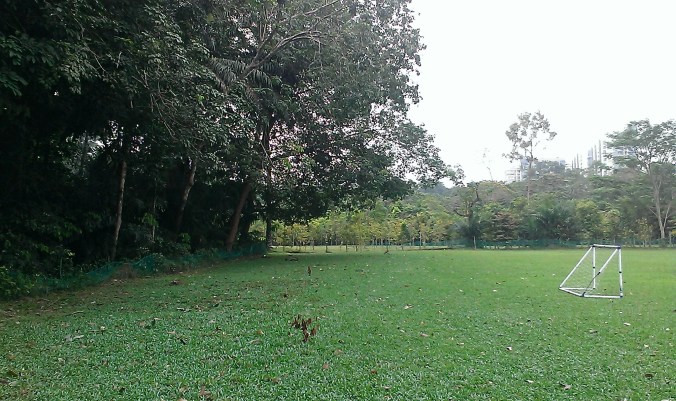
The forest beside the lawn

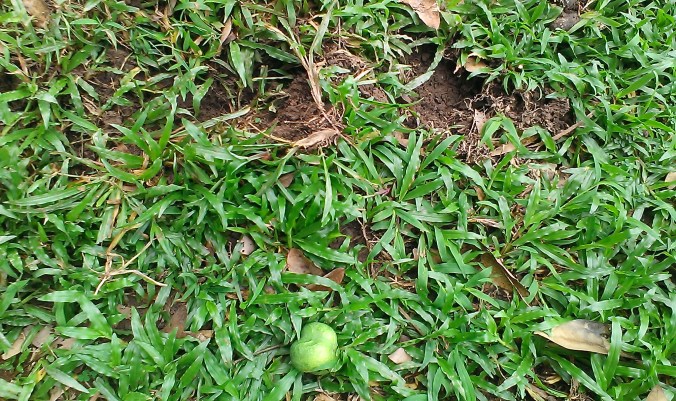
On a pleasant Sunday morning, I observed some interesting happenings along the edge of a forest at Lower Pierce Reservoir where I jog to or play football occasionally. There were some patches of upturned soil on the otherwise flat and trimmed lawn. It was somewhat thrilling because I felt like a detective at a crime scene, gathering clues to figure out what happened. Even better, I also felt like a hunter tracking a prey by reading signs left behind to foretell what might happen in the future. Here’s the story of what I think happened…

2016-06-05 12.10.05

The crime scene: upturned soil and an unknown fruit

Continue reading

Made in Singapore – The Story of Three Veggies

Over the weekend, I gave a talk at a conference in downtown Singapore. The conference is called FutureME and showcases emerging ideas, innovation and trends shaping our future. There were a few speakers addressing urban farming and local food. I guess that people in Singapore are becoming more concerned about food issues.

My talk was probably the shortest. It is a story of three locally grown vegetables. It is a response to the many high-tech growing systems that I am starting to see more of only recently. Hydroponics, aeroponics, aquaponics, indoor growing, soil-less growing, etc. Continue reading

Till Death Do Us Part

A relative of mine passed away recently. We were all saddened by her death, though I could not help but think about certain things during the funeral. I thought about how modern cultures deal with death and how that reflects their relationship with nature.

In most civilizations…

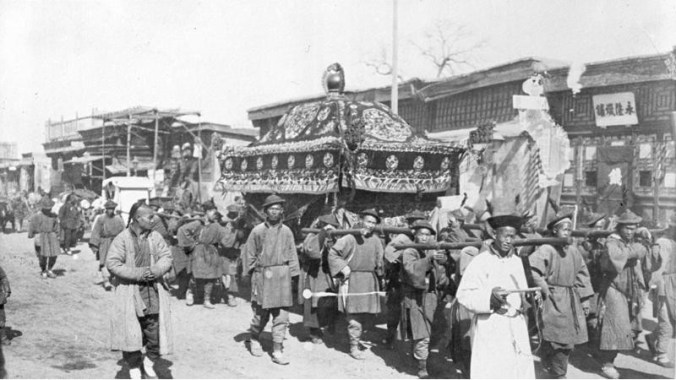
When we die, we chop down a big tree to make a big coffin. Other than the life of the tree, we are taking away lives that the tree is supporting. The birds with their nests gone, the squirrels that eat the fruits, the caterpillars that chew the leaves, the fallen leaves that feed the earthworms. In Chinese customs, the coffin is given much importance. For wealthy families, the coffins can be very big and made of quality wood. They require many bearers to carry. That is probably one of the many contributing causes to the lack of forests in southern China even during the 1900s (read F H King’s Farmers of Forty Centuries). Upon seeing the photo below, my mother told me that her grandmother had a coffin of that size during the 1980s in Singapore. Big trees were still abundant then, I guess.

Bundesarchiv_Bild_137-009055,_Leichenzug_in_Peking

Funeral procession in Beijing, 1900. Source: Wikipedia

Continue reading

Bumi Langit – Make Your Own Heaven

Siang Yu is a friend and fellow farmer at Edible Garden City. She is also an environmentalist and translator. She is currently on a sabbatical in Indonesia. People find it funny that we full-time urban farmers choose to go to farms during leave from work. Here is the first guest post about her trip…


Earlier in January, I went to Yogyakarta because I had heard that permaculture was gaining traction there and I wanted to see it for myself. Thomas and my colleague Imran briefly mentioned Bumi Langit to me once, and I thought it would be a good idea to visit them. Bumit Langit is founded by Iskandar Waworuntu in 2006. He had started a farm in Bali prior to this and I later learned from someone else I met while travelling that Pak Iskandar went to Sumatra to learn about farming. They were a little difficult to contact – I emailed them 2 weeks before I left for Jogja, but never got a reply. So I decided to wing it and found a driver when I arrived in Jogja who could take me and my friend Adiel to Bumi Langit in Imogiri directly.

At Bumi Langit, we met Mas Salas, the person-in-charge of the warung (shop/eatery), when we decided to have dinner there. After learning that I was interested in permaculture and was keen to volunteer with them, Mas Salas sat down with us and we had a very long and engaging chat about permaculture beyond agriculture – permaculture as a lifestyle. It was meeting a kindred spirit. We spoke about capitalism, the pharmaceutical industry and the poison that is television (and Indomie haha). He emphasised the importance of differentiating between human need and human greed. We could choose to fill our lives with junk that we are told we need or we could critically decide for ourselves what the things we truly need are. Rooted in the principles of Islam, Mas Salas said, “Whether we go to heaven after we die, that is decided by God. Why don’t you make your own heaven while you are alive?”

1 Continue reading

Free Range Chicken – To Be Or Not To Be?

Chickens are one of the most commonly kept livestock in the tropics. They are very productive for meat and eggs. Being small, they do not present the challenges of larger livestock like cows and pigs. All-in-all, their widespread presence in rural Asia indicate that chickens are the preferred choice for smallholdings.

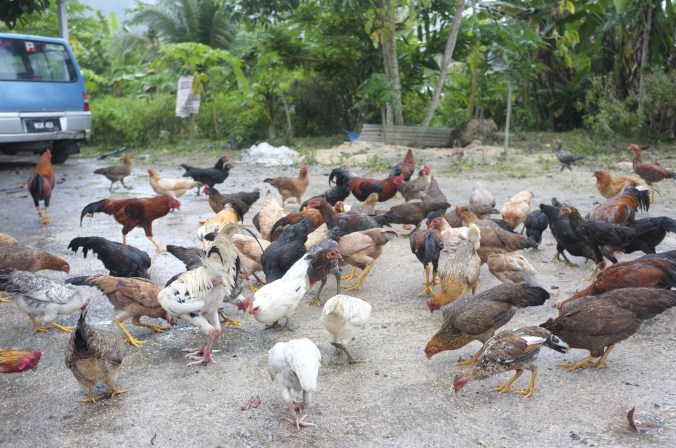
Keeping chickens in battery cages has been a controversial topic of modern industrial farming. Other than the cruelty of immobilizing an animal in a cage barely its size, the widespread use of antibiotics, growth hormones, and other chemicals gives rise to many health concerns. The opposite of battery cage is to let the chickens range freely over a natural vegetated environment.

_DSF1626

Free ranging chickens

While the idea of free range sounds fantastic in theory, there are reasons that some of the farms we have visited do not let their chickens range freely. The chickens there do range but are limited to an enclosed area. Some of the reasons for not letting the chickens range freely include:

  • Attack by predators like snakes, wild boars, eagles, etc.
  • Hygiene considerations since the chickens will not use a designated toilet
  • Messing up the garden by scratching up seedlings and eating vegetables
  • Keeping the eggs to a limited area for ease of searching

Continue reading

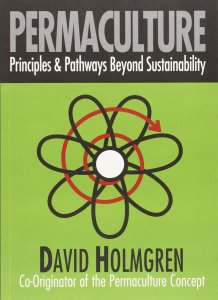
Book Review: David Holmgren’s Permaculture Principles & Pathways Beyond Sustainability

71CQMQ7BjaLI recently came across Permaculture: Principles & Pathways Beyond Sustainability written by David Holmgren at the library. To be honest it wasn’t a book on the top of my must-read list. When one talks about permaculture books, there will be more well-known ones like Bill Mollison’s Permaculture: A Designers’ Manual (a.k.a the permaculture bible) or Toby Hemenway’s Gaia’s Garden. It just happened that I was going to be spending three weeks back in the military as part of mandatory national service and that means lots of spare time to read.
The Author

Lets start with the author. Some of you might have heard of David Holmgren because he was the co-orginator of the permaculture concept together with Bill Mollison. Mollison was actually Holmgren’s professor at that time. The first time they introduced the permaculture concept to the public was in Permaculture One in 1978. At that time Holmgren was only 23 years old. Talk about precociousness!

Holmgren did not co-author the other permaculture books that Mollison published thereafter. He was also less prominent in public with teaching and spreading permaculture than Mollison. So what has he been up to? It was 24 years between 1978 when he published Permaculture One and 2002 when this book was published. Apparently Holmgren has been spending all this time testing and refining his theories on different sites in Australia. I was very interested in seeing what this guy has to say after all these years. Continue reading

Project Merbok – Pioneering on a Lallang Hill

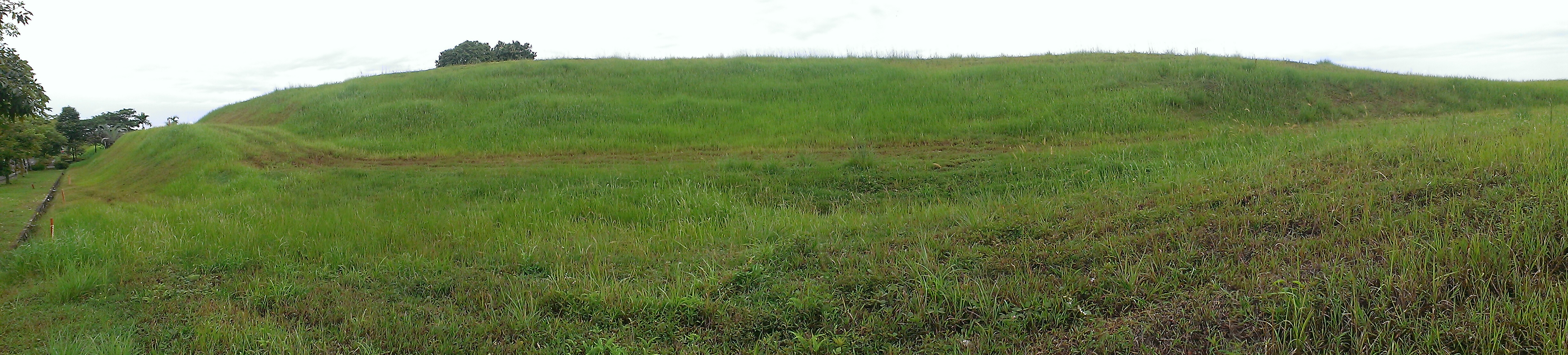
We are beginning to design and build a productive and pretty garden using permaculture principles on a 1.3 acre land in Johor Malaysia! The owner will be building a small house as a retreat for his company staff. This will be a place of relaxation with fruit trees, vegetables and herbs for visitors to harvest. There will also be ponds, small livestock (chickens, ducks, rabbits, bees), rainwater harvesting, and more.

Looking up on to the hilltop from the west where the road is

Looking up on to the hilltop from the west where the road is

Continue reading

Treehouses – Skyscrapers in the Malaysian Rainforest

_DSF1478

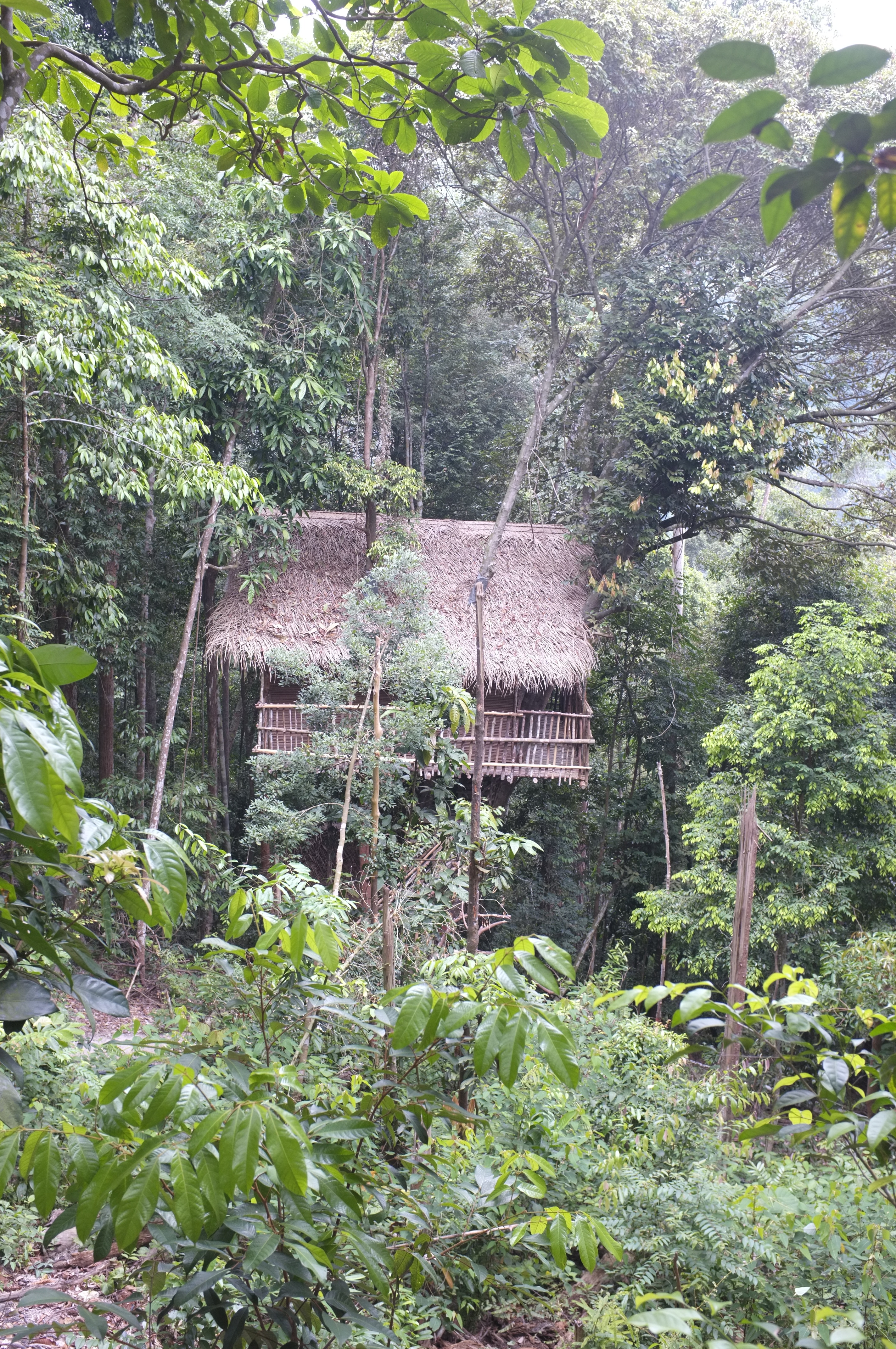
A treehouse that can sleep a dozen adults!

We tend to think of a treehouse as something for kids to hide in and spend a lazy afternoon reading. Do you know that there are traditional people who spend their entire lives staying in treehouses? We visited a place in southern Malaysia with treehouses for adults (and kids alike). It is located at the foot of the mountain Gunung Pulai.

Previously, I wrote about the traditional Malay houses of Malaysia. They are typically constructed with wood and built on stilts with pitched roofs. Contrary to the simple aesthetics, the house is highly sophisticated and designed to handle the climate of the humid tropics to keep inhabitants as comfortable as possible without the need for energy-consuming technologies like air-con.

Treehouses have existed in Malaysia for a long time as well, probably even way before the traditional Malay houses. They are the traditional houses of the Orang Asli (literally “original people” in Malay language). The Orang Asli are hunter-gatherers and reside in the rainforests of Malaysia. They can put together a treehouse with nothing more than a parang (machete), a saw, a hammer and some nails. The materials (wood, bamboo, and palm fronds) are all taken from the forest. Continue reading

Creating Terra Preta and Using Urine to Fertilize

We have been farming at Project Spectra for close to a year. The rooftop conditions are especially challenging with the heat and wind. Only certain plants that can adapt to these conditions do better at our garden, like beans and legumes.

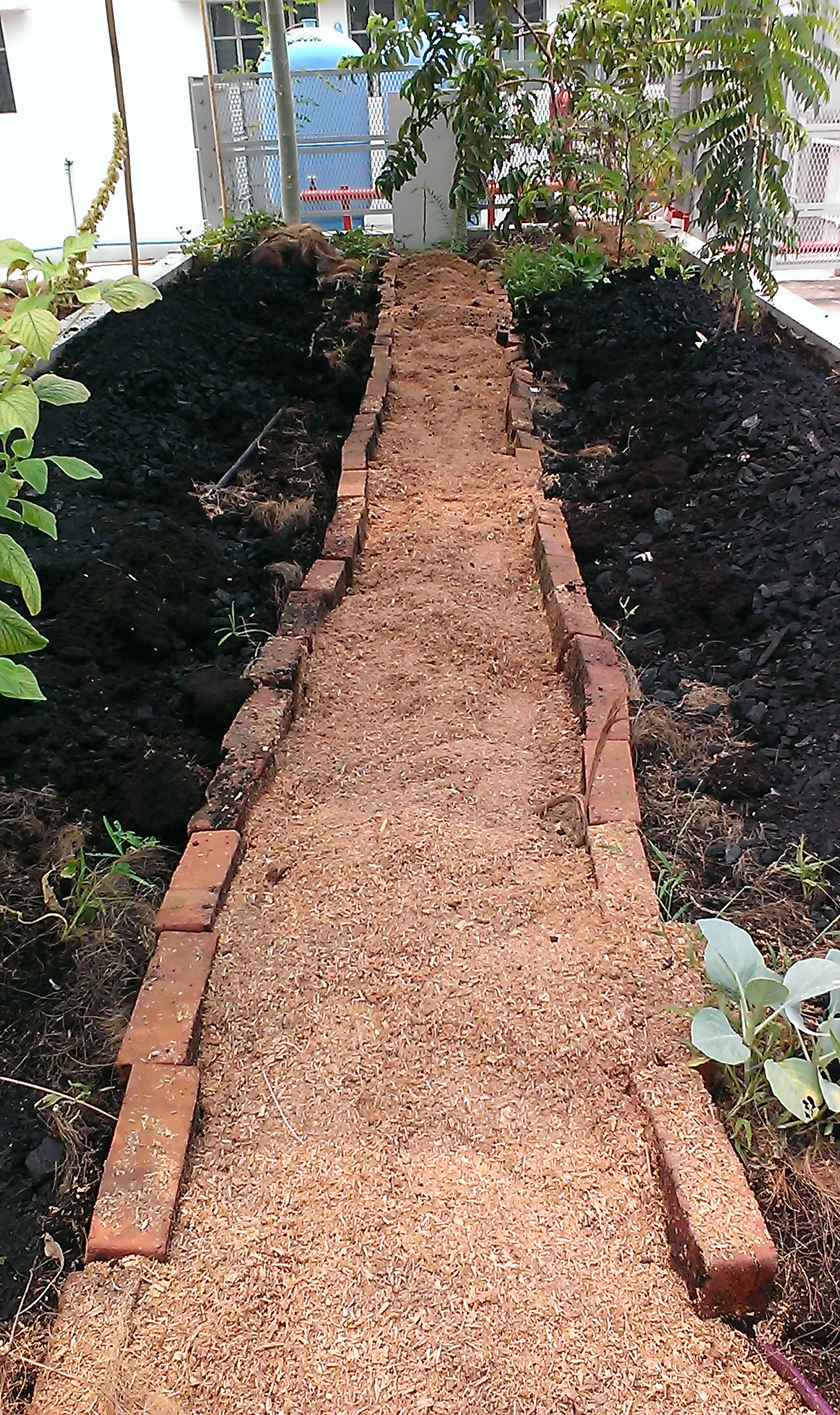
2015-09-08 13.46.26 During the school holidays, we decided to do some soil amendment by adding biochar. Terra preta is man-made soil created by an ancient farming method in the Amazon Basin between 450 BC to AD 950. It literally means “black earth” because of the high charcoal and humus content in the soil. The ancient farmers have digging charcoal into the soil sometimes up to a depth of 2 meters. There are a few reasons for doing so:

  1. Biochar reduces nutrient leaching which is a major problem in places with very high rainfall, like the Amazon Rainforest and Singapore. Much of the plant nutrients are water-soluble and they get washed away during a heavy rain into the rivers (or in the case of SIngapore, the drains). Charcoal is extremely porous so they have a very high surface area to volume ratio and these pores hold on to the nutrients.
  2. The high porosity characteristic of charcoal also encourages microbial activities in the soil. They provide spaces for bacterial and fungi that help with the ecosystem of the soil.
  3. Biochar is slightly alkaline and helps to balance the pH of tropical soil, which is typically acidic.
  4. Biochar helps to moderate the wet and dry cycles in the soil. The numerous pores absorb moisture when the soil is wet and release them when the soil is dry. The roots of most plants enjoy a condition where it is moist enough but not too wet that they suffocate without air.
  5. Lastly, biochar will last a very long time in the soil. Unlike compost or ash, it doesn’t break down. This is why we still find Terra Preta in the Amazon after thousands of years. Talk about permanent agriculture!

Continue reading

Permaculture Perak: Living beside a Jungle

There are many organic farms in Malaysia, but I have been searching for one that is not growing commercially to sell to the market. I am more interested to see subsistence agriculture rather than market-oriented agriculture. Subsistence agriculture is when the farmer grows to feed the family and sell the produce only if there is excess. There is a big difference between both. Permaculture Perak is one of the few that I found. It is located in the state of Perak in northern Malaysia, a short drive from charming Lenggong town. To access the land, you would most likely need a 4-wheel drive because of the steep uphill climb into 500m altitude.

2015-06-13 10.02.18

Approaching the main house, with a fruiting durian tree beside it!

Ladia and Amy live on the land with their two year old daughter and newborn son. Their neighbours are gibbons, wild boars, snakes, scorpions, and every once in a while an elephant who ransacks the kitchen for soy sauce. The only human neighbours are far away, down in the town of Lenggong. Continue reading