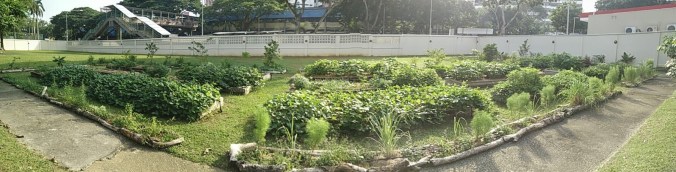
Project Panchor – Converting Oil Palm Plantation to Food Forest

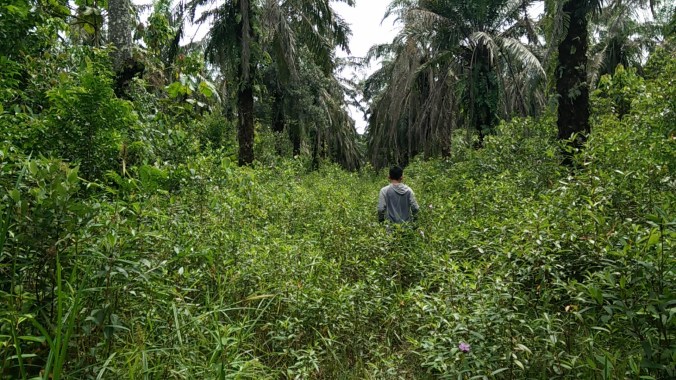
We are helping Ricky transform the oil palm plantation on his 7.25 acre family land to a food forest based on permaculture principles. The oil palm monoculture was planted about 20 years ago but has been left fallow since then. No one has been harvesting the fruits. Over time, the understorey has been vegetated naturally and become dense with shrubs and small trees.
IMG_20161209_133708

Ricky walking in the dense shrubs under mature oil palms

Ricky became interested in permaculture a few years back and we met when I gave a talk on permaculture at a farmers’ market in Johor. We kept in contact but it was only recently that he resolved to turn his dream into reality. He wants a piece of land where his kids can play in nature, instead of spending weekends in a mall. We talked about industrial agriculture, societal issues, environmental destruction, etc, where we shared similar views.

Oil palm monocultures have become the most common landscape in Johor; a drive around here will convince you of that. They have a bad reputation for causing deforestation (by burning or mass clearing), eutrophication of water bodies through use of chemical fertilizers, reduced biodiversity, soil erosion, and other issues. After two cycles of planting, the soil will be completely degraded and the land unproductive. We are reversing the clock – turning an old oil palm plantation back into a polyculture forest using ecological methods. We have not seen any precedents and hope that whatever we learn can be used by many others to heal the land. Continue reading
Project Lombong – Designing for Water and Access

We came up with the initial design for the 10-acre Project Lombong after a couple months of deliberation. The first thing that we implemented was earth-shaping for water and access. The heavy machines would need to do their work before we start planting. After that it would be difficult for the machines to maneuver freely.

Lay of the Land

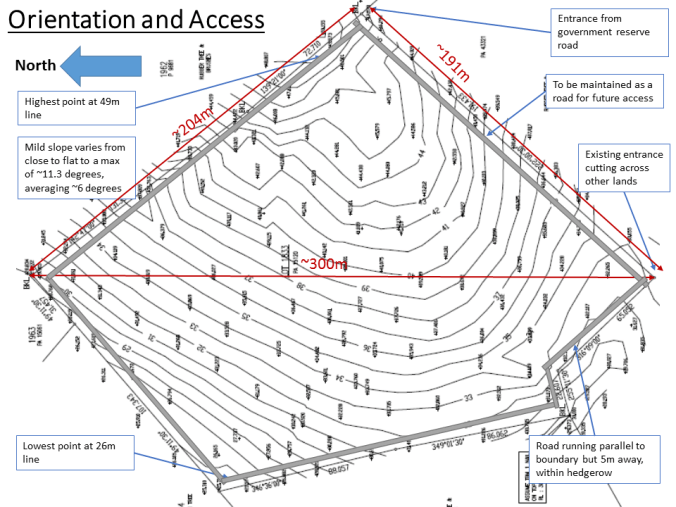
The highest point of the land is on the eastern corner at 49m elevation (top center on map below). From there, it slopes down to the west, ending at the western corner at 26m elevation (bottom left on map). The slope is mild: averaging about 6 degrees, with a maximum of 11.3 degrees. The shape of the slope is a ridge; there are no valleys.

EGC - Design for Kevin's Land 2017-02 v3

We planned for roads to run along the boundary. They will be 5m from the edge to allow space for a hedgerow. Due to the heavy rains here, the earthworks contractor double-cambered the roads (highest point in the middle, sloping down to the sides) to help drainage. Some of the water will be diverted into swales to soak into the soil.

road

After digging the mudtrack, Kevin’s 4-wheel drive got stuck on the road once during a rain. He then decided to put gravel on the roads to help with traction.  We were very lucky that the earthworks contractor found some spots on the land with red gravel. Those gravel will be excavated and spread on the sloping roads. These spots would then become ponds. That would save lots of money. Local experience is so important! Continue reading

Companion Planting in the Tropics – Vertical Stacking

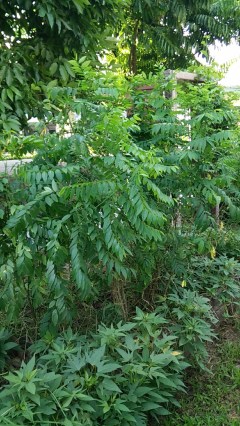
Sweet potato and katuk (sweet leaf/sayur manis)

We have been playing around with companion planting at Project Canossian. Actually it’s more of stacking plants on top of one another rather than just adjacent. Lots of failures with some successes. It is something we have been experimenting with since our days at Project Green Valley. There are many good reasons why you would want to companion plant by vertical stacking:

  • Better use of sunshine: Here in Singapore 1 degree north of the equator, the sun is overhead throughout the year. As Bill Mollison says, a resource that isn’t properly utilized can become a pollution. Sunshine is photosynthesized by leaves and is turned into a yield (for us or other living things). However, when this strong sunshine falls on the soil many things happen. Soil water evaporates, soil organisms (e.g. earthworms) die from the heat, ambient temperature increases due to radiation. A single layer planting of small vegetables or herbs does not use the sunshine efficiently. Lets talk about planting lettuce as an example: for most of the growing duration, most of the sunshine will fall between the tiny seedlings onto the soil. Even when the lettuces are fully grown and touching one another, the leaves are not able to utilize all that good sunshine. One layer of leaf can only photosynthesize so much sunlight, after which the remaining passes through the leaf. Which is why the best use of sunshine here in our climate is still a forest. Almost all of the solar energy would be extracted as the sunshine passes through the many layers. Nothing much is left by the time it reaches the forest floor.
  • Better use of rainfall: Likewise, we are blessed (or, to poly-tunnel farmers, cursed) with heavy rains throughout the year. The kinetic energy of falling raindrops causes soil compaction and sheet erosion when not absorbed by foliage or mulch. Having more leaves to intercept and direct the water flow down the stems allows the soil to drink more gently. If there are not enough roots in the soil to absorb the rain it flows away, causing leaching of nutrients.
  • Shading out weeds: Nature doesn’t waste. Solar energy that falls on soil will be taken up by weeds. Mulching helps but we have seen weeds here that can penetrate mulch (cardboard or leaves) just to reach for sunlight.

Continue reading

Lazy Way of Food Waste Composting

IMG_20170116_113039

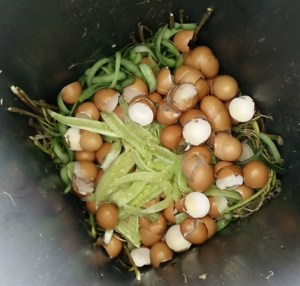
Food waste collected in a bin

We started food waste composting a few months ago in the garden at the Canossian School. The food waste comes from the children’s home and the sisters’ quarters. We have a food waste bin each outside the two kitchens that we collect once or twice every week. The chefs throw fruit peels, vegetables cuttings, and egg shells into the bins. We don’t take dairy, meat, and oil because they are much harder to compost. The smell will be stronger and there will be more pests like rodents.

Most people associate food waste with stench. It can be true because food waste tends to be high in moisture and nitrogen. It breaks down fast and the process can become anaerobic (no air) since it’s so wet. That causes the smell. To solve this issue, one can add materials that are high in carbon and low in moisture. Some materials that would work include sawdust, wood chips/clippings, dried leaves, old newspaper/cardboard, and straw. Continue reading

Project Canossian – Tree Belt (Part 3)

img_20161117_121153

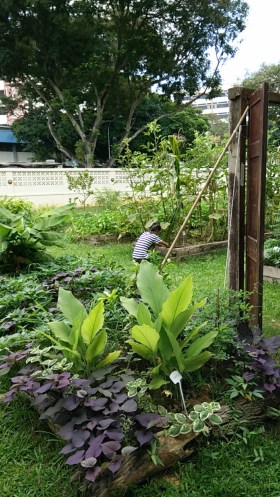
Tree belt on the left, veggie beds behind

When we designed the food garden at the Canossian School, we placed a tree belt around the perimeter of the garden. The trees, when they have grown bigger, will protect the vegetable raised beds in the middle. They will provide:

  1. Partial shade
  2. Wind protection
  3. Fertility in the form of leaf litter
  4. Wildlife and biodiversity

We picked about 30 types of small to medium sized fruit trees. They would be placed at the left, right, and back of the garden. While it would be great to have some big durian and mango trees, the space was limited and we wanted fruits that the kids can pick easily to snack on.

We planted them as a simplified food forest with a few layers – tubers (underground), ground cover, shrubs, creepers, and small trees. Continue reading

Project Lombong – Ten acres of bare soil…

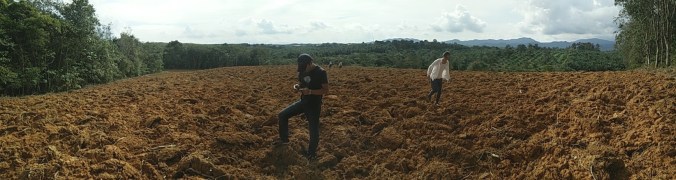
We are starting on a 10-acre piece of land in Johor, Malaysia. It is situated close to Kota Tinggi, a place north-east of Singapore known for fireflies and waterfalls. Kevin approached us recently about this land owned by his family. He wants to do organic farming on it and provide good livelihoods to people working there. The majority of the area will be a mixed fruit orchard but there will be aquaculture and vegetables too. He does not have any farming experience, but we felt that he has good intentions and is someone we can work with.

pano_20161103_160126

View from the highest point

The land was previously a 3 year old rubber monoculture plantation. When we met him, the land had already been cleared of vegetation by a tractor. He said that the contractor was going to dig up all the tree roots and dispose of them. We recommended against that for many reasons:

  • The roots, despite being dead, still holds the soil together against erosion on his sloping land. Over time, they will rot and act as a slow-release fertilizer.
  • Digging mixes up the naturally-formed soil horizons and disrupts all the organisms in the soil.
  • Aerating soil in this manner introduces a rush of oxygen into the soil. That’s a short-term benefit with long-term losses. With the high temperature and moisture here, this means that organic matter and humus decompose rapidly and become lost as carbon dioxide to the atmosphere.
  • Without any big trees or plants to absorb the suddenly available nutrients, they will be lost to the atmosphere (oxidized) or washed away by the rain (leached).

After the first meeting, we scheduled a date to visit the land. Continue reading

Project Canossian – Chop-and-Drop (Part 2)

Sounding as bad-ass and violent as natural farming (not industrial farming) can ever get, chop-and-drop is actually a really effective gardening technique. Simply put, one chops the existing plant down and drops them right away on the spot where the next plant is to grow. Combined with green manuring, it is an excellent way to kickstart your garden

pano_20160823_165717

Green manure growing out of the beds

Our previous post on Project Canossian ended with a round of green manure. Over the next month or two, the green manure helped to:

  • Fix nitrogen: roots of legumes (beans and peas) act symbiotically with certain fungi to convert nitrogen in the air to the soil for plants to absorb
  • Create biomass: the vigorous growth means that you get a mass of organic matter for mulching when you chop-and-drop
  • Settle the soil: gives time for the newly poured soil and compost to stabilize

Continue reading

Project Canossian – Building A Garden With Waste (Part 1)

A few months back, we built a food garden for the Canossian School in Singapore. They work with kids with hearing impairment and the school principal Terry wanted a sensory garden for the kids to develop all their senses. She lamented a few times about how children nowadays do not get to pull things out of the soil.

Canossian School is very fortunate because they actually have unused space for a garden. We have spoken to many schools that want a food garden but do not have any space left. We would walk the school grounds to find that everywhere has been concreted or planted with trees. Canossian School has a sizeable and flat grass patch and we were allocated about 35m x 11m for the garden.

2015-12-04-10-47-12

The possibilities are endless, like a blank canvas.

Analyzing the Site

Before even thinking about garden design, we needed to understand the site. From a distance, we noticed many bare patches that grass did not grow on. That’s not a good sign. The type of vegetation growing on it was odd as well. Walking the ground, we immediately noticed that the soil was soft. It was not the spongy softness of a soil with good structure and many pores. It was a muddy kind of softness like wet pottery clay. As expected, there had been major soil works about a year ago. We learned that there is construction waste like concrete rubble beneath the soil. There is no top soil but just a layer of yellow clay. It’s not a great start but we are used to all these in urban environments. Continue reading

Building A Treehouse In The Rainforest

A while back, I posted about my visit to a place in Johor Malaysia where treehouses sit in the canopy of the rainforest. A few months later, I went back to help Ah Yao (founder of Rainforest Treehouse), Salim and Wira, two Orang Asli (literally “original people” in Malay language), build another treehouse. The four photos below show from start (left) to almost finish (right).


Continue reading

Project Merbok – Windbreak

_DSF2252

Being the highest point on this open grassland means lots of wind!

We finally started work on Project Merbok a few months back. One of the most important things we started with was to create windbreaks. You might ask: what’s wrong with enjoying a breeze in our warm humid climate? While a gentle wind helps with air circulation, too much of it causes many problems.


  • Soil erosion: Organic matter (dead leaves, dried twigs) are very light and will get blown away easily. That leaves the soil exposed and also takes away the nutrition from rotting matter that the soil needs.
  • Dryness: Wind removes moisture from the soil and plants. It’s the same principle as sunning your clothes on a windy day. Without moisture in soil, micro-organisms and earthworms die. Without moisture in soil, roots can’t bring water up to leaves.
  • Energy wastage: Plants would have to expend energy to resist wind to stay upright. They would be reaching for the sun but pushed sideways by the wind. The wasted energy could be better used for biomass growth or food production. Compared to trees, grasses deal with wind much effectively. That’s the reason you see so much lalang on this site!
  • Mechanical damage: Malaysia is quite sheltered by surrounding islands and typically do not suffer from typhoons. However, there are still windstorms that can uproot big trees. Even if the plant is well-rooted, the leaves can be mechanically damaged by the wind itself or rubbing against other leaves.

Continue reading